

Cognitive Memory Database for AI Agents
Persistent cognitive memory for AI agents.
Your agent forgets your project between sessions. YantrikDB remembers — as an embeddable Rust engine, a Python package, an MCP server, or a replicated cluster.
pip install yantrikdbcargo add yantrikdbdocker pull ghcr.io/yantrikos/yantrikdb


Three ways to run it
Same engine in all three. Pick the one that matches where your memory should live.
Memory for a coding agent you already use.
The MCP server exposes memory as tools. Your client decides when to call them — the server ships instructions describing when memory should be used.
pip install yantrikdb-mcp codex mcp add yantrikdb -- yantrikdb-mcp or Claude Code, Cursor, Windsurf - Best for
- Giving an existing assistant memory across sessions
- Control
- The host client decides when a tool fires
- Scope
- One developer machine, one store
Shared memory, replicated across nodes.
The server wraps the engine with authentication, multi-tenancy and YRP native replication, so several clients share one memory.
yantrikdb serve --data-dir ./data start command Before this works: Create a database and token before connecting a client. Server quick start →
- Best for
- Several agents or people sharing one memory
- Adds
- Auth, multi-tenancy, replication, failover
- Cost
- Infrastructure to run and operate
Several agents, one memory
The network layer is what makes memory shared. Each client authenticates, the server scopes it to a database, and they read and write the same store.
- Claude Code
- Cursor
- Your service
- yantrikdb-server token auth · database per tenant
- One store namespaces scope records, recall, sessions, tasks
- Replicas YRP replication · leader election · failover
Sharing happens through the server. The embedded engine and the MCP server are single-process — they own their own store and do not share it between machines. Client names are examples of MCP-compatible hosts, not integrations unique to this mode.
Memory that survives the handoff
One decision, three agents, and a shared store. The film follows a real captured trace through recall, namespace isolation, history, conflict review, and the memory lifecycle.
Read the transcript
Monday: Atlas moved. Thursday: another agent drafts the opposite.
Not careless. It has no memory to check.
With YantrikDB, the second agent asks first, and gets the decision, the source, and why it surfaced.
It is scoped. Atlas facts live in Atlas's namespace, and nowhere else.
It knows who owns it, and what it touches.
Procurement changed the answer. The record was corrected, not overwritten, so the old belief is still inspectable.
The store recognizes conflicting claims and routes them for review. Your policy decides.
Stale context fades. Related fragments consolidate when you ask. Important memories rise for attention.
Three agents. Three transports. One shared store.
YantrikDB. Memory that just works.
Memory Lab
Section titled “Memory Lab”Store three memories, recall against them, then store a fourth that
contradicts the first — Acme is based in Boston. then Acme is based in Denver. — and run db.think(). It returns conflicts_found: 1, and both
records still come back on the next recall, each carrying the dispute.
This runs in your tab. Rust compiled to WebAssembly — SQLite, the vector index and the scoring pipeline all local. No server, no API calls, nothing stored anywhere, and the state disappears when you reload.
One honest limit: the bundled embedder does not compile to wasm, so this page hashes words into 64-dim vectors instead of embedding them. The ranking is real; the embedding quality is not representative of the shipped engine.
What the demo will not pretend to show
Two numbers a four-memory store cannot honestly move, so the demo names them rather than printing a zero:
- Consolidation waits for
min_active_memories: 10. - Pattern mining is off in the default config.
Every other number on screen comes back from the engine itself. Nothing declares
a schema — the extractor reads a headquartered_in claim out of each sentence,
and that relation holds one value at a time, which is why the fourth memory
registers as a conflict rather than an update.
Why this memory surfaced
A recall returns more than a list. Each result carries the signals the engine used to rank it, so you can see why something came back rather than trusting that it should have.
A worked example. Four memories stored, one query run, output captured from the engine itself and committed as a fixture — not computed on this page, and not written by hand.
who is blocked on the auth rewrite - #1 The payments migration is blocked on the auth rewrite. 0.520why_retrieved
semantically similar (0.83)recentimportant (decay=0.80)- similarity
- 0.832
- decay
- 0.800
- recency
- 1.000
- importance
- 0.800
- valence multiplier
- 1.090
- #2 Alice leads the payments team. 0.191why_retrieved
recentimportant (decay=0.90)- similarity
- 0.337
- decay
- 0.900
- recency
- 1.000
- importance
- 0.900
- valence multiplier
- 1
- #3 Standup moved to 09:30 on Tuesdays. 0.066why_retrieved
recent- similarity
- 0.127
- decay
- 0.300
- recency
- 1.000
- importance
- 0.300
- valence multiplier
- 1
These signals do not add up to the score, and they are not meant to. They are diagnostic magnitudes that combine under the engine's scorer — some multiplicatively, some not — so reading them as percentages of a total would be wrong. Notice that #2 carries higher importance and decay than #1 and still ranks below it: similarity dominated.
Vectors are the demo's deterministic hash embedder, not the shipped embedder, which does not compile to wasm. No lexical signal appears here because the browser recall takes an embedding only.
The Problem
Section titled “The Problem”Many first-pass agent-memory systems follow the same loop:
Store everything. Embed. Retrieve top-k. Inject into context. Hope it helps.
That loop alone does not model a memory lifecycle. Without additional machinery, old memories do not decay, related records are not consolidated, and conflicting structured claims are not surfaced for review.
YantrikDB is built around those four gaps.
Every memory is treated as equal
Relevance gates every other signal multiplicatively — a perfectly relevant old memory surfaces, an irrelevant high-importance one does not.
Removing the additive recency wall moved end-to-end MRR from 0.054 to 0.541 on a labelled production clone.
Retrieval detail →Old memories never fade
Temporal decay and consolidation run as a cognition pass rather than a cron job, so the store settles instead of only growing.
The write path →Contradictions are never detected
Store “Acme is based in Boston.” then “Acme is based in Denver.” and think() returns conflicts_found: 1 — no schema declared, no rule written.
Detection works over relations the extractor recognises — here headquartered_in, which holds one value at a time — not over arbitrary sentences.
Run it yourself →Nothing is ever connected
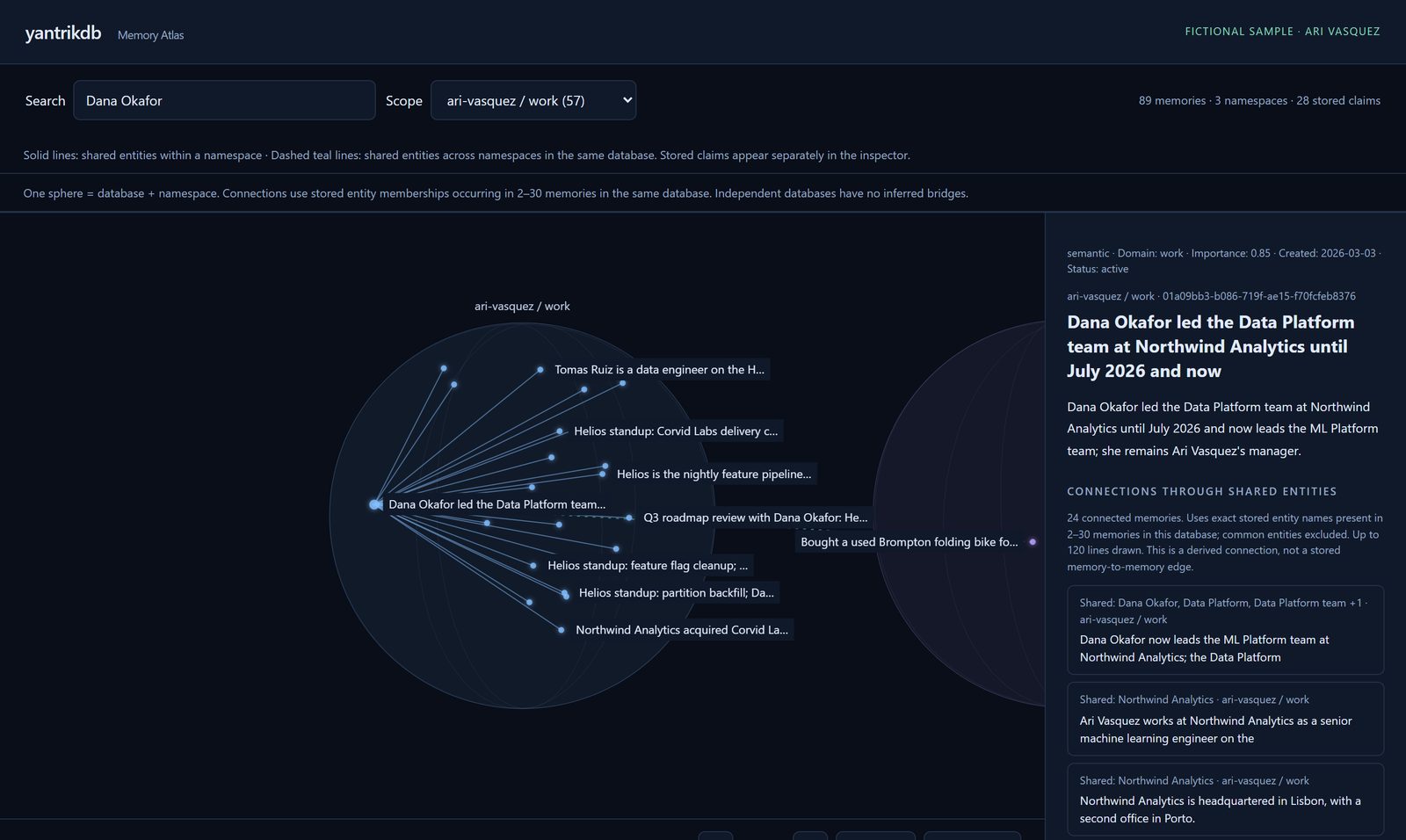
Typed nodes and typed edges — beliefs, goals, preferences, joined by supports, contradicts, causes — so recall can follow structure, not just similarity.
Cognitive state graph →Encryption at rest, Knowledge Packs, cluster mode and the rest of the capability detail: what the engine does →
What it actually does
Those four gaps are the argument. This is the surface that answers them — grouped by what you are trying to do, with the real method names, because a capability you cannot call is a slogan.
Recall & ranking 6 Category spans Engine / PythonMCPServer HTTPBrowser (wasm)
Retrieval that returns why it returned something, not just what.
- recall
recall / recall_text - Rank by relevance and return a final score with retrieval reasons. Richer engine/Python surfaces expose the signal breakdown; leaner transports return the score and reasons.
- Point-in-time recall
recall_as_of - Ask what the store believed at a past moment, not just what it holds now.
- Refine a recall
recall_refine - Narrow an existing result set instead of re-querying from scratch.
- Recall with links
recall_with_links - Pull a memory together with the records it is linked to.
- Relevance feedback
recall_feedback - Mark a result useful or wrong and let ranking learn from it.
- Entity expansion
recall(expand_entities=True) - Optionally widen a query along known entity edges; off by default so graph expansion is used deliberately. Opt-in per call. Enabling it by default measured worse on the cited set, so it is a deliberate choice rather than a mode.
Isolation & lifecycle 7 Category spans Engine / PythonMCPServer HTTPBrowser (wasm)
Memory that is scoped, and that ages instead of only growing.
- Namespace isolation
namespace= - Records, recall, sessions, tasks, procedures and statistics can be scoped by namespace. The network layer adds token-scoped tenant databases; namespace is a second scope inside an authenticated database where supported. The browser build uses a fixed default namespace.
- Temporal decay
half_life / decay - A half-life lowers a memory's ranking weight over time, so stale material stops dominating recall. Affects ranking weight — it does not destructively rewrite the stored importance.
- Correct a memory
correct / history - Correct in place while appending an auditable revision-history entry; entity links stay attached to the same record.
- Forget
forget - Tombstone a record so it stops surfacing.
- Archive and hydrate
archive / hydrate - Move cold memories out of the hot path and bring them back on demand.
- Temporal queries
stale / upcoming / range (or recall since/until) - Find what has gone stale, what is coming up, and retrieve records from a bounded time window.
- Maintenance cycle
run_maintenance_cycle / maintenance_debt - Run upkeep explicitly and see what work is outstanding.
Entities & graph 6 Category spans Engine / PythonMCPServer HTTPBrowser (wasm)
Structure between memories, not just similarity between vectors.
- Relate
relate / unlink - Typed, weighted edges between entities.
- Auto-relate
auto_relate - Preview or persist co-occurrence-derived entity edges.
- Search entities
search_entities(pattern, entity_type, limit) - Find entities by pattern and type.
- Entity profile
entity_profile - Everything the store knows about one entity, assembled.
- Read edges
get_edges - Traverse what an entity is connected to.
- Relationship depth
relationship_depth - How far apart two entities sit in the graph.
Cognition 6 Category spans Engine / PythonMCPServer HTTPBrowser (wasm)
The pass that notices contradictions instead of storing both quietly.
- think()
think(config) - A bounded, incremental pass: consolidation and conflict scanning over what changed. Pattern mining is opt-in and off by default.
- Conflict detection
scan_conflicts / get_conflicts - Two claims that cannot both hold are flagged rather than silently coexisting. Covers recognised structured single-valued relations — not general natural-language inference over arbitrary sentences.
- Resolution
resolve_conflict / reclassify_conflict - An operator confirms which claim stands, with a note attached to the decision. Operator-driven by design; the database does not guess.
- Disputed results
disputed_with - Both sides of an open conflict keep coming back marked, so an agent can hedge.
- Knowledge gaps
knowledge_gaps - Questions asked often and answered badly, surfaced as gaps.
- Substitution categories
substitution_categories - Distinguish a real conflict from a redundant restatement.
Agent primitives 6 Category spans Engine / PythonMCPServer HTTP
The things an agent needs beyond storing text.
- Sessions
session_start / session_end / session_digest - Start, end and digest a working session; read its history.
- Triggers
get_pending_triggers / deliver_trigger / acknowledge_trigger - Proactive follow-ups the store raises, delivered and acknowledged.
- Tasks
task_add / task_list / task_update - Track work items alongside the memory they belong to.
- Procedural memory
record_procedural / surface_procedural / reinforce_procedural - Learn, surface and reinforce reusable strategies.
- Skills & outcomes
skill (MCP) · /v1/skills/* - A schema-validated skill catalog with semantic search and an append-only record of how each skill actually performed. Skill writes over MCP are operator-gated and off by default; reads and search are not.
- Conversation ring
record_turn / recent_turns - Recent turns kept as a rolling window for context.
Deployment & security 6 Category spans Engine / PythonMCPServer HTTP
What changes when memory stops living in one process.
- Encryption at rest
is_encrypted - AES-256-GCM over the store. Explicitly enabled, not automatic — engine, Python and host configuration. Encrypted mode can limit text extraction and search behaviour.
- Knowledge Packs
seal_pack / sign_pack / mount_pack / install_pack - Portable memory that can be sealed, signed, published and mounted into another store. Publisher trust, signature verification and embedder compatibility are part of the claim. Pack writes and trust changes over MCP are operator-gated.
- Tenancy
database / token - Token-scoped databases on the network layer, separate from in-database namespaces.
- Replication
cluster / health / metrics - Multi-node deployment with leader election and failover via YRP native replication.
- Persistence provenance audit
audit_leak_candidates - Find recent memory rows that lack both an originating oplog record and replication provenance.
- Provenance gating
provenance gate - Control what the store will accept based on where it came from.
Three experiments worth reading
Section titled “Three experiments worth reading”Each one is the same shape: a real corpus, a question that a plain vector store answers badly, and a result you can inspect. Chosen because they test what the engine claims to do — hold conflicting accounts without silently picking one — not because they cover the widest range of subjects.
All eight experiments, with methodology →
Your agent's memory failed. Bring the smallest version.
Replace private history with a tiny fictional timeline. We trace the write, extraction, indexing, recall, ranking, lifecycle, and integration path, then publish a reproducible diagnosis.
- 01Reproducesynthetic timeline + exact versions
- 02Localizethe first failing lifecycle stage
- 03Resolvefix, regression test, or documented boundary
The ecosystem
One engine, and everything built around it. Grouped by what each piece actually is — a release artifact is not a product, and an experiment is not a supported component.
Flagship
The three pieces on independent release trains.
Ships with the server
Release artifacts of yantrikdb-server, not separate products.
Integrations
Adapters into other ecosystems.
Capability
An engine capability and distribution channel, not a separate product.
Built with YantrikDB
Demonstrations, not installable components.
Labs
Experimental. Not part of the supported surface.
Full component detail, version lines and architecture: components reference →